Embarking on a countertop replacement or installation project involves more than just picking a material you love. The process of obtaining and comparing quotes can be complex, with numerous variables influencing the final cost and outcome. This guide provides a structured approach to understanding, dissecting, and comparing countertop quotes, empowering you to make informed decisions and ensure your project aligns with your expectations and budget.
As senior editor for Renovation Standard, our goal is to equip you with the tools to navigate significant home improvements confidently. This checklist and framework are designed to help you identify hidden costs, clarify assumptions, and ensure you're comparing apples to apples across different bids. By following these steps, you'll gain a comprehensive understanding of what each contractor is offering, from the initial slab selection to the final installation details.
Use this guide as your personal project manager. Start by reviewing the master checklist to understand the breadth of details involved. Then, apply the comparison framework to each quote you receive, meticulously filling in the blanks. Pay close attention to the red flags section to protect your investment. This systematic approach will not only save you potential headaches and unexpected expenses but also help you secure the best value for your countertop project.
Laying the Groundwork: Defining Your Countertop Project Scope
Before you even solicit a single quote, a clear understanding of your project's scope is paramount. This foundational work ensures that every contractor bids on the same set of requirements, making comparisons far more accurate and meaningful. Begin by meticulously documenting your existing space and your vision for the new countertops.
Initial Measurements and Layout
Measure your current countertops, noting all dimensions, angles, and any unusual features. Sketch a rough layout of your kitchen or bathroom, indicating the location of sinks, cooktops, outlets, and any adjacent walls or appliances. This initial sketch, even if rudimentary, provides a common reference point for all bidders.
Material Preferences and Alternatives
Research various countertop materials, considering their aesthetics, durability, maintenance requirements, and cost. While you may have a primary material in mind (e.g., quartz, granite, marble, solid surface, laminate), be open to exploring alternatives. Different materials have distinct fabrication and installation requirements, which directly impact pricing. Understand that material availability and specific technical requirements, including structural support for heavier materials, must be verified locally.
Budget Ranges and Priorities
Establish a realistic budget range for your project. This isn't just about the material cost; it includes demolition, fabrication, installation, and any ancillary services like plumbing or electrical work. Prioritize what's most important to you: a specific aesthetic, maximum durability, or cost-effectiveness. Communicating your budget range and priorities to contractors can help them tailor their bids more effectively, potentially offering value-engineered solutions.
Ancillary Work and Project Dependencies
Consider what other work might be necessary or desirable in conjunction with your new countertops. Will you be replacing cabinets? Upgrading your sink or faucet? Installing a new cooktop? These elements can affect the timing and complexity of the countertop installation. For a comprehensive overview of managing your overall project budget, consult our Renovation Budget Calculator.
Soliciting Quotes: What to Ask and Who to Ask
The quality of your quotes directly correlates with the quality of information you provide and the contractors you engage. Aim to obtain at least three detailed bids from reputable professionals. This step is critical for ensuring competitive pricing and a clear understanding of services.
Vetting Contractors and Fabricators
Before inviting anyone to bid, conduct thorough due diligence. Verify that the contractor or fabricator is properly licensed and insured in your locality. Request references from recent projects and follow up on them. Look for companies with a strong track record of quality workmanship and customer service. The Federal Trade Commission (FTC) advises checking with your state attorney general's office and local consumer protection agencies for any complaints against a contractor. [1]
Initial Information to Provide to Bidders
When you contact potential contractors, provide them with a consistent set of information. This should include:
- Your project scope document (measurements, desired materials, layout sketch).
- Any specific requirements (e.g., desire for a particular edge profile, need for a specific sink cutout).
- Your preferred timeline for the project.
- Questions about their process, from templating to installation.
Be clear about what you expect in their quote: a line-item breakdown of all costs, including materials, labor, and any additional services.
The Site Visit and Discussion
A reputable contractor will want to visit your home to take their own measurements, assess the existing conditions, and discuss your project in detail. This is an opportunity to ask questions, clarify your vision, and gauge their professionalism and expertise. Pay attention to how they communicate and whether they seem to understand your needs. Discuss potential challenges, such as access to your home for large slabs or the need for temporary plumbing solutions.
Deconstructing the Quote: The Master Checklist for Comparison
This section is the heart of your comparison process. Each quote you receive should be broken down into its constituent parts. Use this detailed checklist to ensure nothing is overlooked and that you can accurately compare each bid side-by-side.
I. Material Specifications
- Material Type: Is it precisely what you requested (e.g., "Carrara Marble" vs. "marble-look quartz")?
- Specific Product Name/Series: For engineered materials (quartz, solid surface), is the exact manufacturer and product line specified?
- Color/Pattern: Is the specific color or pattern name included?
- Thickness: Is the thickness (e.g., 2cm, 3cm) clearly stated?
- Quantity: How is the material quantity calculated? (e.g., square footage, number of slabs).
- Slab Specifics (for natural stone):
- Number of slabs quoted.
- Allowance for waste/remnants.
- Is slab selection included, or is it based on a standard grade?
- Are there any upcharges for specific slab characteristics (e.g., exotic veining)?
- Sealer/Treatment: Is a sealer or protective treatment included for natural stone? If so, what type and how many applications?
II. Fabrication Details
- Edge Profile: Is the specific edge profile (e.g., eased, bullnose, ogee) clearly defined and priced? Are there different prices for different edges?
- Cutouts:
- Sink cutout (undermount, drop-in, farmhouse). Is the type and number specified?
- Cooktop cutout.
- Faucet holes (number and size).
- Other cutouts (e.g., outlets, soap dispensers).
- Backsplashes:
- Height and thickness of backsplash material.
- Number of linear feet.
- Edge treatment for backsplashes.
- Seams:
- Number and location of seams.
- Method of seam fabrication (e.g., color-matched epoxy).
- Is seam polishing or blending included?
- Overhangs: Are standard or custom overhangs specified? Are supports for large overhangs included?
- Polishing/Finishing: Is all exposed material polished or finished to the desired standard?
III. Installation Services
- Demolition and Removal:
- Removal of existing countertops.
- Disposal fees for old materials.
- Protection of surrounding areas during demolition.
- Templating: Is professional templating included? What is the timeline for templating after cabinets are set?
- Delivery: Is delivery of new countertops to the site included? Are there any access restrictions or fees for difficult deliveries?
- Installation Labor:
- Hourly rate or flat fee for installation.
- Number of installers.
- Estimated installation time.
- Site Preparation: Who is responsible for ensuring cabinets are level and ready for installation?
- Cleanup: What level of cleanup is included post-installation?
- Ancillary Services (if included in quote):
- Plumbing disconnection/reconnection (sink, faucet, disposal).
- Electrical disconnection/reconnection (cooktop, outlets).
- Cabinet modifications.
IV. Other Costs and Terms
- Permits: Who is responsible for obtaining any necessary local permits? (Note: Local permits, licensing, contracts, technical requirements, and property conditions must be verified locally.)
- Taxes: Are all applicable sales taxes included?
- Warranty: What warranty is offered on materials and labor? How long does it last? What does it cover?
- Payment Schedule: What are the deposit requirements and payment milestones?
- Change Order Policy: How are changes to the scope handled and priced? (For more on managing project changes, see our Renovation Change Order Checklist.)
- Insurance: Confirmation of liability and worker's compensation insurance.
- Timeline: Estimated lead time from template to installation.
Define the Template-Ready Conditions
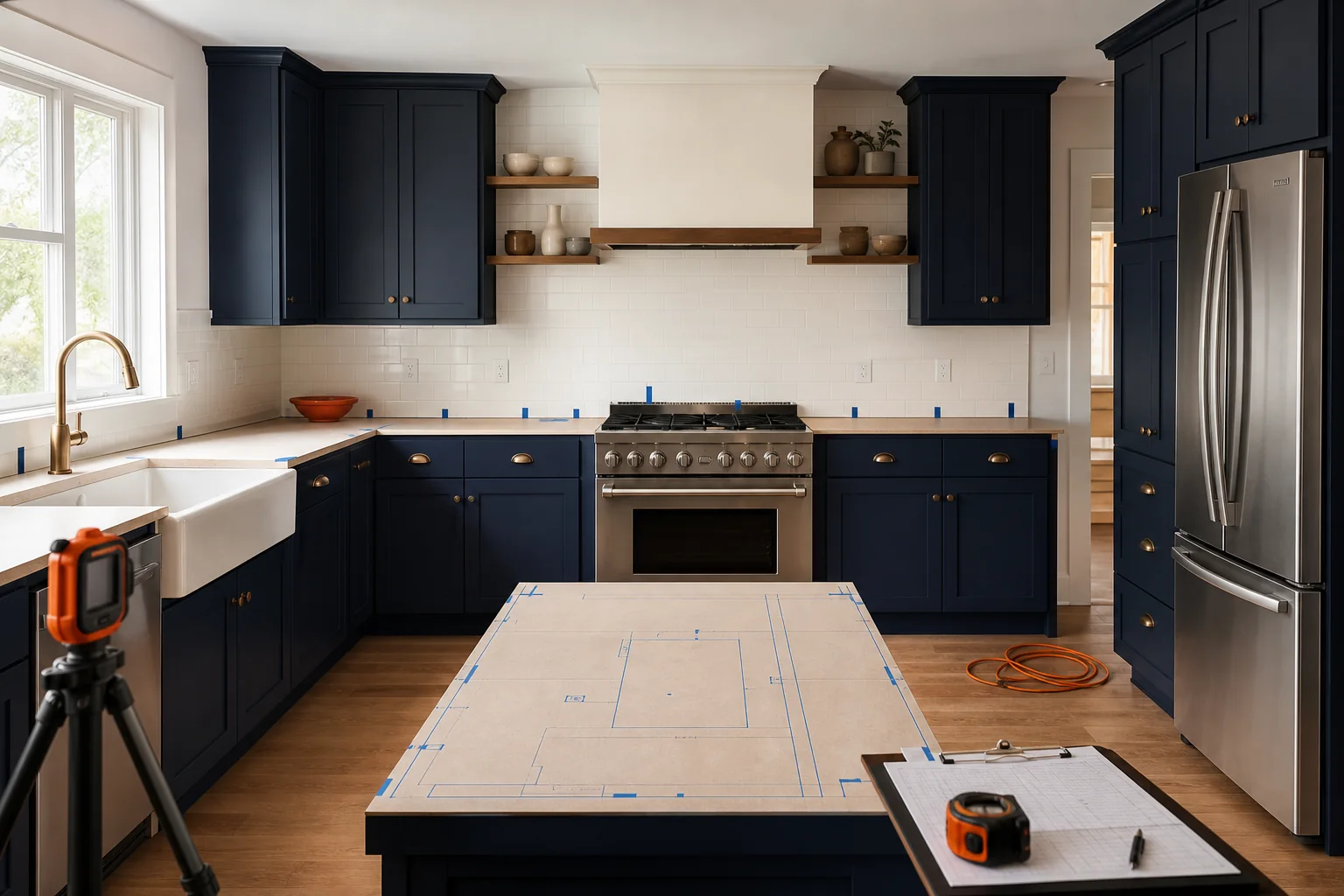
The templating phase is a critical step that dictates the precision of your new countertops. It's when exact measurements and specifications are taken to ensure a perfect fit. However, the accuracy of the template relies heavily on the readiness of your space. Understanding and preparing for template-ready conditions is essential to avoid delays and costly re-fabrication.
Cabinets Must Be Installed and Leveled
Before templating can occur, all base cabinets must be fully installed, securely fastened, and perfectly level. Any discrepancies in cabinet height or alignment will translate directly to an uneven countertop. Ensure your cabinet installer has completed their work and that you've verified the stability and levelness of all units. This includes any island cabinets or peninsula extensions.
Appliances in Final Position
Any appliances that will be integrated into or sit adjacent to the countertops must be on-site and in their final, fixed positions. This includes your sink, cooktop, dishwasher, and refrigerator. The fabricator will need to measure around these items precisely to ensure cutouts and clearances are correct. For undermount sinks, the actual sink basin must be present for the template to be made accurately. Similarly, if you have a slide-in range or a downdraft ventilation system, these must be available for precise measurement.
Clearance and Access
Ensure the work area is clear of obstructions. Remove any temporary countertops, loose items, or construction debris. The templating team needs unimpeded access to all areas where countertops will be installed. Discuss with your contractor any specific access requirements for large slabs or equipment, especially if your home has narrow doorways or staircases.
Final Decisions on Overhangs and Edge Profiles
By the time templating occurs, you should have made all final decisions regarding countertop overhangs, particularly for islands or breakfast bars, and your chosen edge profiles. These details are incorporated directly into the template. Changes after templating can lead to significant delays and additional costs.
Normalize Edges, Cutouts, Seams, and Supports
These specific fabrication details are often where quotes can diverge significantly. Understanding the nuances of each element allows for a more precise comparison and helps you anticipate the final aesthetic and functional outcome of your countertops.

Edge Profiles: Aesthetics and Cost
Countertop edges come in a vast array of profiles, from simple eased or bevel edges to more elaborate ogee or bullnose designs. Each profile requires different levels of fabrication skill and time, directly impacting the cost. Ensure the quote specifies the exact edge profile for all exposed edges. If different edges are used in different areas (e.g., an eased edge on the perimeter, an ogee on an island), confirm these are itemized separately.
Cutouts: Precision and Type
Every cutout for a sink, cooktop, or faucet requires precise measurement and cutting. Undermount sinks, for instance, require a highly polished edge around the cutout, which is more labor-intensive than a drop-in sink cutout. Farmhouse sinks often require custom cabinet modifications and precise cutouts. Verify the number and type of all cutouts included in the quote, and ensure they match your appliance and fixture selections.
Seams: Placement and Visibility
Depending on the size and layout of your countertops, seams may be unavoidable, especially with natural stone slabs or large engineered stone installations. Discuss with your fabricator the proposed location of any seams. Reputable fabricators will strategically place seams in less conspicuous areas, such as near a sink or cooktop, and will use color-matched epoxy to minimize their visibility. The quote should ideally mention the number of seams and their general placement. Understanding the fabricator's approach to seam quality is crucial, as poorly executed seams can detract significantly from the overall appearance.
Overhangs and Structural Supports
Standard countertop overhangs are typically 1 to 1.5 inches beyond the cabinet face. However, if you desire larger overhangs, particularly for islands or breakfast bars, structural support may be required. This can include steel rods, corbels, or other reinforcement. Ensure the quote addresses any necessary supports for your desired overhangs, as these can be a significant additional cost and are critical for the longevity and safety of your countertops. Local building codes and technical requirements for structural support must be verified locally.
Understanding Material Assumptions and Slab Specifics
The material itself is often the largest component of your countertop cost. However, the way that material is sourced, measured, and accounted for can vary significantly between quotes. Delving into these details is essential for accurate comparison.
How Material is Priced: Square Footage vs. Slab
Some materials, particularly engineered quartz or solid surface, are often quoted per square foot. Natural stones like granite and marble, however, are typically purchased by the slab. If your project requires only a portion of a slab, you might still need to purchase the entire slab, with the remainder becoming "waste" or a "remnant." Clarify how each quote accounts for material quantity and whether you are paying for full slabs or only the usable square footage.
Veining, Pattern Matching, and Waste
For natural stone or engineered materials with prominent veining or patterns, the aesthetic outcome depends heavily on how the fabricator plans the cuts. Discuss "vein matching" or "pattern matching" for seams and corners, as this requires more material and meticulous planning, potentially increasing cost. Ask about the estimated waste factor. A fabricator who plans cuts efficiently can save you money by minimizing waste, especially if you're paying for full slabs. Some fabricators may offer to use remnants for smaller projects like bathroom vanities or window sills, which can be a cost-effective solution.
Material Grade and Quality
For natural stones, there can be variations in grade, which impact both appearance and price. While "grade" isn't a universally standardized term, it often refers to the consistency of color, presence of fissures, or rarity of the stone. Ensure the quote specifies the grade or quality level of the material. For engineered products, verify the manufacturer and product line, as quality can vary between brands. When considering different materials, be mindful of their potential impact on indoor air quality. Some materials, particularly those containing resins or adhesives, can off-gas volatile organic compounds (VOCs). The Environmental Protection Agency (EPA) provides guidance on remodeling and indoor air quality, suggesting good ventilation during and after installation.
Allowance for Slab Selection
If you're opting for natural stone, the ability to personally select your slabs from the stone yard is highly recommended. This ensures you are happy with the unique characteristics, veining, and color variations of your specific pieces. Confirm whether the quote includes an allowance for slab selection or if it's based on a standard inventory without client input.
Navigating the Fine Print: Inclusions, Exclusions, and Red Flags
A quote is more than just a price tag; it's a legal document outlining the scope of work. Understanding what is explicitly included and, more importantly, what is excluded, is vital. This section also highlights common red flags that should prompt further investigation or caution.
What's Not Included?
Often, the most significant discrepancies between quotes lie in what they *don't* cover. Meticulously review the exclusions. Common exclusions might include:
- Plumbing disconnection/reconnection.
- Electrical work (cooktop, outlets).
- Cabinet modifications or reinforcement.
- Removal and disposal of old countertops.
- Temporary countertops during fabrication.
- Permit fees (if required locally).
- Patching or painting walls after backsplash installation.
If an item is not explicitly listed as included, assume it is excluded and budget for it separately or seek clarification from the contractor. For a structured approach to comparing contractor bids, consider using a Contractor Quote Comparison Scorecard.
Payment Schedules and Deposit Requirements
A typical payment schedule involves an upfront deposit, progress payments, and a final payment upon satisfactory completion. Be wary of contractors who demand a very large upfront deposit (e.g., more than 30-50%) or insist on cash-only payments. The Federal Trade Commission (FTC) advises against paying for the entire job upfront. [1] Ensure the payment schedule is tied to specific milestones, not just dates.
Warranty on Materials and Labor
Understand the warranty offered on both the material itself (often from the manufacturer) and the installation labor (from the fabricator/installer). What does it cover? How long does it last? What voids the warranty? Get these details in writing.
Common Red Flags in Quotes and Contractor Behavior
- Vague or Incomplete Descriptions: Quotes that lack detail on material specifics, edge profiles, or installation steps.
- Extremely Low Bids: While competitive pricing is good, a bid significantly lower than others can indicate corners being cut, inferior materials, or hidden costs.
- High-Pressure Sales Tactics: Contractors who demand an immediate decision or offer steep "today-only" discounts.
- No Written Contract: Always insist on a detailed, written contract that mirrors the quote.
- Lack of Licensing/Insurance Proof: Refusal or inability to provide current license and insurance certificates.
- Cash-Only Demands: A strong preference for cash payments can be a sign of an unprofessional operation.
- Requests for Full Payment Upfront: As mentioned, this is a major red flag.
- Unsolicited Offers: Be cautious of contractors who show up at your door offering deals.
If you encounter any of these red flags, proceed with extreme caution or consider seeking alternative bids.
Plan Installation and Handoff
The installation day is the culmination of your planning. A smooth installation requires careful coordination and preparation. Understanding the process and what to expect during and after installation will help ensure a successful outcome and a proper handoff of your new countertops.

Site Preparation Before Installation
Your contractor should provide a checklist of items you need to complete before their arrival. This typically includes:
- Clearing the work area: Remove all items from cabinets, drawers, and countertops.
- Protecting floors and furniture: Cover adjacent flooring and furniture with drop cloths or plastic sheeting.
- Ensuring clear access: Make sure pathways from the entry point to the kitchen or bathroom are clear for installers to carry heavy slabs.
- Disconnecting utilities: If plumbing or electrical work is not included in the countertop quote, ensure your plumber/electrician has disconnected the sink, faucet, cooktop, and any other relevant appliances.
Confirm who is responsible for these tasks to avoid last-minute confusion or delays.
During Installation: What to Expect
Installation day can be noisy and dusty. Expect the process to take several hours, or even a full day, depending on the complexity. Installers will carefully bring in the slabs, position them, make final adjustments, and secure them to the cabinets. They will then seal any seams and apply a final polish or treatment if applicable. Be available to answer questions, but allow the professionals to work without constant interruption. If you have specific concerns about dust or debris, discuss them with your contractor beforehand.
Post-Installation Walkthrough and Punch List
Once the installation is complete, conduct a thorough walkthrough with the lead installer. Inspect the countertops for any damage, chips, scratches, or imperfections. Check the alignment of seams, the finish of edge profiles, and the fit around sinks and appliances. Test the stability of the countertops. If you identify any issues, document them immediately and create a "punch list" of items that need correction. Do not make final payment until all items on the punch list have been satisfactorily addressed.
Final Payment and Warranty Registration
Upon satisfactory completion of all work and resolution of any punch list items, you will make your final payment. At this time, ensure you receive all relevant documentation, including:
- A copy of the signed contract and final invoice.
- Lien waivers from the contractor and any subcontractors or material suppliers, confirming they have been paid and will not place a lien on your property.
- Manufacturer warranties for the countertop material.
- Care and maintenance instructions for your specific countertop material.
Register your product warranty with the manufacturer if required. For a comprehensive guide to wrapping up your renovation, refer to our Home Renovation Closeout Checklist.
Worked Example: Applying the Comparison Framework
To illustrate how to use this checklist, let's consider two hypothetical quotes for a kitchen countertop project. We won't invent market prices, but focus on how the details (or lack thereof) reveal differences.
Project Scenario:
Homeowner needs new kitchen countertops (approx. 50 sq ft), including an undermount sink cutout, a cooktop cutout, and a 4-inch backsplash. Desired material: a specific brand/color of quartz. Edge profile: Eased.
Quote A (Detailed & Transparent)
| Category | Item | Details from Quote A |
|---|---|---|
| Material | Quartz Slab | "QuartzPro" brand, "Arctic White" color, 3cm thickness. 2 full slabs (55 sq ft total) required due to layout. Includes allowance for pattern matching. |
| Material Cost | $X.XX per sq ft (total $Y.YY for 55 sq ft) | |
| Fabrication | Edge Profile | Eased edge, polished on all exposed edges (40 linear ft). |
| Sink Cutout | Undermount sink cutout, polished. (Homeowner to provide sink model #). | |
| Cooktop Cutout | Drop-in cooktop cutout. (Homeowner to provide cooktop model #). | |
| Faucet Holes | 3 faucet holes (standard 1.5" diameter). | |
| Backsplash | 4" tall, 3cm thick backsplash, eased top edge (30 linear ft). | |
| Seams | 1 seam, located at corner of L-shape, color-matched epoxy. | |
| Installation | Demolition | Removal and disposal of existing laminate countertops (50 sq ft). |
| Templating | Professional laser templating included. | |
| Delivery & Install | Delivery to site, professional installation by 2-person crew. | |
| Cleanup | Basic site cleanup post-installation. | |
| Exclusions | Plumbing disconnection/reconnection, electrical work, cabinet modifications. | |
| Payment Terms | 30% deposit, 40% after templating, 30% upon satisfactory completion. | |
| Warranty | 10-year manufacturer warranty on quartz, 1-year labor warranty. |
Quote B (Less Detailed)
| Category | Item | Details from Quote B |
|---|---|---|
| Material | Quartz Countertops | White quartz, 3cm. 50 sq ft. |
| Material Cost | $A.AA per sq ft (total $B.BB for 50 sq ft) | |
| Fabrication | Fabrication | Standard fabrication. |
| Cutouts | Sink & cooktop cutouts. | |
| Backsplash | 4" backsplash. | |
| Installation | Installation | Includes removal of old tops. |
| Exclusions | (Not explicitly stated) | |
| Payment Terms | 50% deposit, 50% upon delivery. | |
| Warranty | Standard warranty. |
Comparison Insights:
- Material Quantity: Quote A clearly states 55 sq ft (2 slabs) needed for a 50 sq ft project, accounting for waste/pattern matching. Quote B only lists 50 sq ft. This could mean Quote B is underestimating material, leading to a change order, or it's assuming a different, less desirable slab layout.
- Material Specifics: Quote A specifies "QuartzPro Arctic White." Quote B just says "White quartz." This lack of specificity in Quote B could mean a lower-grade or different brand of quartz, impacting quality and appearance.
- Fabrication Details: Quote A details the edge profile, specific cutout types (undermount vs. drop-in), and even seam location. Quote B uses vague terms like "standard fabrication" and "cutouts," leaving critical details open to interpretation and potential upcharges.
- Backsplash: Quote A specifies 3cm thickness for the backsplash, matching the countertop. Quote B doesn't specify thickness, which could mean a thinner, less substantial backsplash.
- Demolition: Quote A explicitly includes disposal. Quote B only says "removal," leaving disposal costs ambiguous.
- Exclusions: Quote A clearly lists what's NOT included, allowing the homeowner to plan for these services. Quote B is silent on exclusions, a major red flag that could lead to unexpected costs.
- Payment Terms: Quote A's payment schedule is tied to project milestones, reducing homeowner risk. Quote B's "50% upon delivery" is risky, as issues might only become apparent during or after installation.
- Warranty: Quote A provides specific warranty durations. Quote B's "standard warranty" is too vague and requires clarification.
Conclusion: While Quote B might appear cheaper on the surface due to a lower per-square-foot material cost or fewer line items, Quote A provides a far more comprehensive and transparent picture of the project. The homeowner can confidently compare Quote A's offerings, knowing what they are getting and what they need to arrange separately. Quote B would require extensive clarification and likely lead to unforeseen costs and frustrations.
Closeout and Recordkeeping: Securing Your Investment
The project isn't truly complete until all documentation is in order. Proper closeout and meticulous recordkeeping protect your investment, simplify future maintenance, and provide valuable information for any potential warranty claims or future home sales.
Final Documentation Checklist
Upon project completion and final payment, ensure you have collected the following essential documents:
- Signed Contract and All Change Orders: The original contract, along with any formal change orders that were approved during the project.
- Final Invoice and Proof of Payment: A detailed final invoice reflecting all work completed and proof that all payments have been made.
- Lien Waivers: Signed lien waivers from the general contractor, countertop fabricator, and any significant subcontractors or material suppliers. These documents confirm that they have been paid in full and waive their right to place a mechanic's lien on your property.
- Manufacturer Warranties: Original warranty cards or certificates for your countertop material. Ensure these are registered if required by the manufacturer.
- Care and Maintenance Instructions: Specific guidelines for cleaning and maintaining your new countertops to preserve their appearance and longevity.
- Contact Information: A list of contact details for the contractor, fabricator, and any other key personnel involved in your project.
Creating a Project Binder
Organize all these documents into a dedicated project binder or a digital folder. This central repository should also include:
- Your initial project scope and design ideas.
- All quotes received, even those not accepted, for reference.
- Photos taken before, during, and after the installation.
- Notes from meetings or phone calls with the contractor.
- Receipts for any materials you purchased separately.
This binder serves as a comprehensive history of your countertop project, invaluable for future reference. For a broader perspective on managing all aspects of your home renovation, explore our Kitchen Remodel Planning Guide.
Long-Term Benefits of Good Recordkeeping
Good recordkeeping extends beyond the immediate project. It can:
- Facilitate Warranty Claims: If an issue arises, having all warranty information and proof of purchase readily available streamlines the claims process.
- Aid in Future Repairs or Remodels: Knowing the exact material, color, and installer can be crucial if you need to match a repair or extend your countertops in the future.
- Increase Home Value: When selling your home, providing prospective buyers with a detailed record of improvements, including warranties, can instill confidence and potentially increase perceived value.
- Provide a Reference for Future Projects: You'll have a clear record of what worked well (or didn't) with a particular contractor or material, informing your choices for subsequent home improvements.
Frequently Asked Questions (FAQs)
Q1: What if quotes vary wildly in price?
Significant price discrepancies are a strong indicator that the quotes are not for the same scope of work or quality of materials. Use the comparison checklist to identify exactly where the differences lie. One contractor might be including demolition, plumbing, and a higher-grade material, while another is quoting only basic fabrication and installation of a standard material. Don't automatically choose the lowest bid; instead, seek clarification from each contractor to ensure you're comparing equivalent proposals. It's possible the lowest bid has omitted crucial steps or materials, which will lead to unexpected costs later.
Q2: Can I buy my own countertop slab or material?
Yes, in many cases, you can purchase your own slab or material directly from a wholesaler or retailer. However, be aware that this shifts the responsibility for material defects, transportation, and potential damage during transport from the fabricator to you. Some fabricators prefer to source materials themselves, as they often have established relationships and can get better pricing or have specific requirements for the materials they work with. If you do buy your own material, ensure the fabricator is willing to work with it and clarify who is responsible for any issues that arise with the material itself.
Q3: Should the countertop quote include plumbing and electrical work?
It depends on the contractor and your project scope. Some full-service kitchen and bath remodelers will include these services, either performing them in-house or subcontracting them. Many countertop fabricators, however, specialize only in the countertops themselves and will explicitly exclude plumbing (sink/faucet disconnection/reconnection) and electrical (cooktop disconnection/reconnection) work. Always clarify this point. If these services are excluded, you will need to hire a licensed plumber and electrician separately. Local licensing and technical requirements for these trades must be verified locally.
Q4: How long does the entire countertop process typically take from templating to installation?
The timeline can vary significantly based on material availability, fabricator workload, and project complexity. Generally, once templating is complete, fabrication and installation can take anywhere from 1 to 4 weeks. Natural stone slabs may have longer lead times if they need to be ordered. Engineered materials might be quicker if they are readily available. Always ask your contractor for a realistic timeline, including potential delays, and ensure it's documented in your contract.
Q5: What if I need to make changes after the quote is accepted or templating is done?
Changes after a quote is accepted, or especially after templating and fabrication have begun, can lead to significant additional costs and delays. These are typically handled through a "change order." A change order is a formal document that outlines the modification, its impact on the project timeline, and any associated cost adjustments. Always get change orders in writing and ensure both parties sign them before proceeding with the revised work. For more detailed guidance, refer to our Renovation Change Order Checklist.
Q6: How do I ensure the color and pattern of the installed countertop match what I saw in the showroom?
For natural stones like granite or marble, variations in color, veining, and pattern are inherent. It is highly recommended to personally select your specific slabs from the stone yard before fabrication. For engineered materials like quartz, while more consistent, slight dye lot variations can occur. Always confirm the specific product name, color code, and manufacturer. If possible, ask to see a full slab or a larger sample of the exact material that will be used for your project, not just a small swatch. This helps manage expectations and ensures you are satisfied with the final appearance.
This guide organizes a project conversation. It is not engineering, legal, code or trade advice. Property conditions and local requirements must be verified by qualified professionals.