Replacing your home's heating, ventilation, and air conditioning (HVAC) system is a significant investment, impacting your comfort, energy bills, and indoor air quality for years to come. Many homeowners focus primarily on the brand and efficiency ratings listed on equipment labels. However, a truly effective HVAC replacement goes far beyond the equipment itself. It encompasses a comprehensive understanding of your home's unique needs, the quality of the design and installation, and the long-term support provided by your contractor.
This guide empowers you to look beyond the surface of HVAC proposals. Instead of simply comparing price tags and SEER2 numbers, you'll learn to evaluate the entire solution being offered. We'll walk you through critical questions to ask, details to scrutinize, and red flags to watch for, ensuring you select a system that is correctly sized, expertly installed, and tailored to your specific comfort goals. Use this framework to systematically compare bids, ask informed questions, and ultimately make a decision that brings lasting value and comfort to your home.
Understanding Your Home's Unique Needs and Your Comfort Goals
Before you even solicit proposals, it's crucial to define what you want your new HVAC system to achieve. This isn't just about replacing a broken unit; it's an opportunity to improve your home's overall comfort and efficiency. A clear understanding of your needs will help you evaluate whether a contractor's proposal truly addresses your priorities.
Beyond Temperature: Humidity, Air Quality, and Noise
While maintaining a comfortable temperature is the primary function of an HVAC system, modern systems can do much more. Consider these factors:
- Humidity Control: Do you experience excessive humidity in the summer or dry air in the winter? Some systems offer advanced dehumidification or humidification capabilities.
- Indoor Air Quality (IAQ): Are allergies, asthma, or general air cleanliness concerns for your household? Discuss options like advanced filtration, UV lights, or dedicated ventilation systems. The Environmental Protection Agency (EPA) emphasizes the importance of good indoor air quality for health.
- Noise Levels: Is your current system excessively loud? Modern variable-speed systems often operate much more quietly.
- Zoning: Do different areas of your home have varying temperature needs? Zoning systems can provide individualized control, improving comfort and potentially saving energy.
Assessing Your Current System and Home Envelope
A thorough assessment of your existing system and home structure is foundational. A good contractor won't just look at your old furnace; they'll consider the whole house as a system.
- Age and Condition of Existing Equipment: Note the age, brand, model, and any known issues with your current furnace, air conditioner, or heat pump.
- Ductwork Integrity: Are your ducts leaky, undersized, or poorly insulated? Faulty ductwork can significantly reduce efficiency and comfort, even with a new system.
- Insulation Levels: Adequate insulation in your attic, walls, and crawl spaces directly impacts your heating and cooling load.
- Window and Door Performance: Drafty windows and doors allow conditioned air to escape, increasing the burden on your HVAC system.
- Air Sealing: Gaps and cracks in your home's envelope can lead to significant energy loss.
The Importance of a Manual J Load Calculation (or equivalent)
This is perhaps the most critical step in proper HVAC system design. A Manual J calculation (or similar industry-standard method) determines the precise heating and cooling loads for your specific home. It accounts for factors like square footage, ceiling height, window types and orientation, insulation levels, local climate, and even the number of occupants. Without this calculation, a contractor is essentially guessing at the right system size.
- Undersized System: Will struggle to maintain comfort on extreme days, leading to continuous operation and premature wear.
- Oversized System: Will "short cycle," meaning it turns on and off too frequently. This wastes energy, fails to adequately dehumidify the air, and causes uneven temperatures.
Insist that any proposal includes documentation of a load calculation. This demonstrates a professional approach to system design, as highlighted by ENERGY STAR's Quality Installation guidelines.

Evaluating Contractor Qualifications and Professionalism
The quality of your HVAC installation is just as important as the quality of the equipment. A poorly installed high-efficiency system will underperform and may fail prematurely. Choosing the right contractor is paramount.
Licensing, Insurance, and References
Always verify a contractor's credentials:
- Licensing: Confirm they hold all necessary state and local licenses for HVAC installation in your area. These requirements vary significantly by jurisdiction.
- Insurance: Ensure they carry adequate liability insurance and workers' compensation. Ask for proof of insurance directly from their provider. This protects you from financial responsibility if an accident occurs on your property.
- References: Request recent references from customers who had similar work done. Contact these references to inquire about their experience, communication, timeliness, and satisfaction with the work.
- Online Reviews: While not the sole factor, check reputable online review sites for consistent patterns of positive or negative feedback.
Communication and Transparency
A good contractor communicates clearly and openly throughout the process.
- Responsiveness: Do they respond promptly to your inquiries?
- Clarity: Do they explain technical details in an understandable way?
- Professionalism: Do they arrive on time for appointments and present themselves professionally?
- Willingness to Answer Questions: Are they patient and thorough in addressing all your concerns, even if you ask the same question multiple times?
Understanding the Proposal Document
A detailed proposal is a hallmark of a professional contractor. It should be more than just a price quote.
- Itemization: Look for a breakdown of costs for equipment, labor, materials, permits, and any ancillary services.
- Scope of Work: The proposal should clearly describe everything included in the installation, from specific equipment models to ductwork modifications, electrical upgrades, and thermostat installation.
- Exclusions: Equally important are items explicitly NOT included in the proposal. This helps prevent misunderstandings later.
- Payment Schedule: A clear schedule of payments, typically with an initial deposit, progress payments, and a final payment upon completion and satisfaction. Be wary of contractors demanding a large upfront payment, as this can be a red flag for home improvement scams.
Deconstructing the Equipment Specifications
The equipment itself is a critical component, but its specifications must be understood in the context of your home and the installation quality.
Efficiency Ratings (SEER2, HSPF2, AFUE) and Their Real-World Impact
These ratings indicate how efficiently a system converts energy into heating or cooling. Higher numbers generally mean lower operating costs, but the actual savings depend on many factors.
- SEER2 (Seasonal Energy Efficiency Ratio 2): For air conditioners and heat pumps, measuring cooling efficiency. The higher the number, the more efficient.
- HSPF2 (Heating Seasonal Performance Factor 2): For heat pumps, measuring heating efficiency. The higher the number, the more efficient.
- AFUE (Annual Fuel Utilization Efficiency): For furnaces, measuring heating efficiency. A higher percentage means more fuel is converted to heat, and less is wasted.
While higher efficiency ratings are appealing, consider the payback period. A significantly more efficient system might have a higher upfront cost that takes many years to recoup through energy savings, especially if your climate is mild or your usage is low. Your contractor should be able to provide estimated energy savings based on your home's specific load calculation and local energy costs.
Sizing: The Goldilocks Principle
As discussed with the Manual J calculation, proper sizing is paramount. An undersized system won't keep you comfortable, and an oversized system will cycle too often, leading to:
- Reduced Dehumidification: Short cycles don't run long enough to remove sufficient moisture from the air, leading to a clammy feeling even at a cool temperature.
- Increased Wear and Tear: Frequent starting and stopping puts more stress on components, potentially shortening the system's lifespan.
- Higher Energy Bills: The most energy-intensive part of an HVAC cycle is starting up.
Ensure the proposed equipment size (in tons for cooling, BTUs for heating) aligns directly with the results of your home's load calculation.
Components and Compatibility
An HVAC system is a collection of interconnected components. Ensure they are designed to work together seamlessly.
- Matched Systems: For split systems (separate indoor and outdoor units), ensure the indoor coil, outdoor unit, and furnace (if applicable) are an ARI (Air-Conditioning, Heating, and Refrigeration Institute) matched system. Mismatched components will not achieve their rated efficiency and may void warranties.
- Thermostat: Is the proposed thermostat compatible with the new system's features (e.g., multi-stage operation, zoning, smart home integration)?
- Ancillary Equipment: If you're adding humidifiers, dehumidifiers, or advanced air filters, ensure they are compatible with the main system and properly integrated.
Scrutinizing the Installation Plan and Scope of Work
The installation plan details how the new system will be integrated into your home. This is where the rubber meets the road, and quality installation is critical for performance and longevity.
Ductwork: The Often-Overlooked Component
Your ductwork is the circulatory system of your HVAC. Even the most efficient new unit will underperform if connected to leaky, undersized, or poorly insulated ducts. ENERGY STAR emphasizes duct sealing and insulation as key components of a quality installation.
- Inspection and Sealing: Does the proposal include a thorough inspection of existing ductwork for leaks and proper sealing? Ask about the methods they will use (e.g., mastic sealant, specialized tapes).
- Sizing and Modifications: Will the existing ductwork be adequate for the new system's airflow requirements? If not, what modifications (e.g., adding return air ducts, enlarging supply runs) are proposed?
- Insulation: Is duct insulation included, especially for ducts running through unconditioned spaces like attics or crawl spaces?
- Airflow Balancing: Will the contractor perform airflow testing and balancing to ensure proper air distribution to all rooms?
Electrical, Refrigerant Lines, and Condensate Drainage
These essential connections must be installed correctly and safely.
- Electrical Upgrades: Does the new system require a dedicated circuit or an upgrade to your electrical panel? Will the contractor handle this or subcontract it?
- Refrigerant Lines: Will new refrigerant lines be installed, or will existing ones be flushed and reused? New lines are often recommended for optimal performance and to prevent contamination. Ensure the contractor specifies proper evacuation and charging procedures.
- Condensate Drainage: How will condensate (water removed from the air) be drained? Is a new drain line needed? Is a condensate pump required? Will a safety switch be installed to shut off the system if the drain clogs, preventing water damage?
Ancillary Equipment and System Integration
Any additional components must be properly installed and integrated.
- Thermostat Installation: Where will the new thermostat be located? Is it in an optimal spot away from direct sunlight or drafts?
- Ventilation: If fresh air ventilation is being added, how will it be integrated and controlled? The EPA recommends proper ventilation to improve indoor air quality.
- Permits: Will the contractor pull all necessary local permits for the HVAC installation and any associated electrical or plumbing work? This is critical for ensuring the work meets local building codes and for your home's resale value.
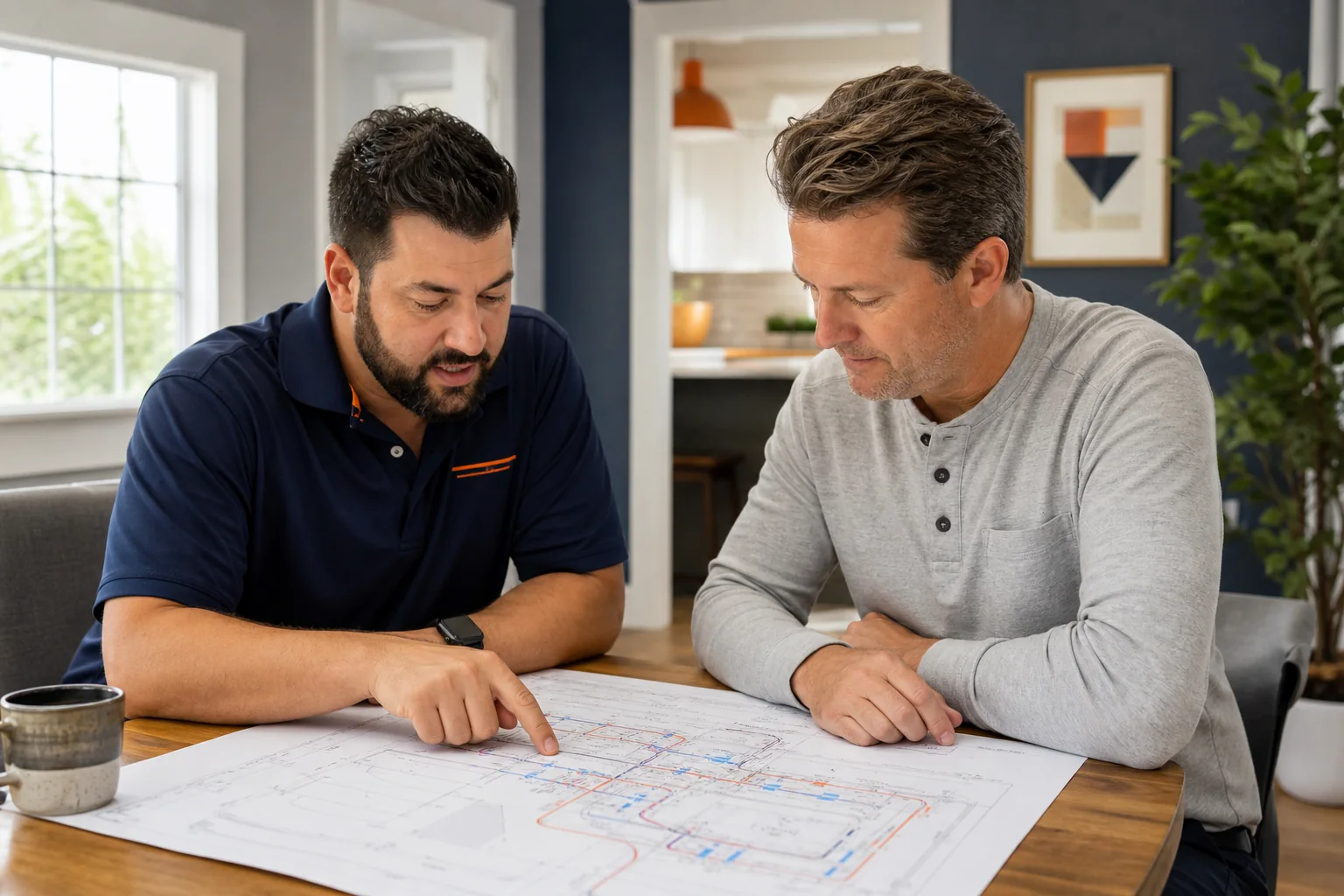
Understanding Warranties, Guarantees, and Service Agreements
A robust warranty and clear service terms provide peace of mind and protect your investment.
Manufacturer Warranties vs. Labor Warranties
Distinguish between these two crucial types of coverage:
- Manufacturer's Warranty (Parts): This covers defects in the equipment itself. Most manufacturers offer a standard warranty (e.g., 5-10 years on parts) and often an extended warranty if the product is registered within a certain timeframe. Ensure your contractor registers the equipment for you or provides instructions on how to do so.
- Contractor's Labor Warranty: This covers the quality of the installation work. A reputable contractor will offer a labor warranty, typically for 1-2 years, covering issues arising from their installation. Ask for the specific duration and what it covers.
Clarify what voids each warranty (e.g., not having annual maintenance, using non-OEM parts). Understand the process for making a warranty claim.
Performance Guarantees and Service Contracts
Some contractors offer additional assurances:
- Performance Guarantees: Rarely offered, but some contractors might guarantee that the system will achieve a certain temperature differential or energy saving. Understand the specific metrics and conditions.
- Service Contracts/Maintenance Plans: Many contractors offer annual maintenance plans. These typically include seasonal tune-ups, filter changes, and inspections. While an additional cost, they can help maintain efficiency, prevent breakdowns, and keep your manufacturer's warranty valid. Ask what is included and the cost.
The Financial Picture: Costs, Payment Schedules, and Incentives
Beyond the bottom-line price, understanding the financial details of your HVAC replacement is essential for budgeting and avoiding surprises.
Itemized Costs and Avoiding Hidden Fees
A transparent proposal breaks down all costs. Look for:
- Equipment Cost: The price of the furnace, AC unit, heat pump, coil, and thermostat.
- Labor Cost: The cost of installation, including removal of old equipment.
- Materials: Ductwork, refrigerant, electrical components, condensate lines, insulation, etc.
- Permit Fees: The cost of obtaining local permits.
- Ancillary Services: Any additional work like electrical upgrades, carpentry, or patching/painting.
- Disposal Fees: For responsibly removing and recycling your old equipment.
Ensure the proposal clearly states that the price is fixed for the agreed-upon scope of work, or outlines how change orders will be handled. For more on managing changes, refer to our guide on Renovation Change Order Checklist.
Payment Milestones and Retainage
A fair payment schedule protects both you and the contractor.
- Initial Deposit: A reasonable deposit (e.g., 10-30%) to secure the job and cover initial material costs.
- Progress Payments: Payments tied to specific milestones (e.g., equipment delivery, major installation completed).
- Final Payment: A significant portion (e.g., 10-20%) should be withheld until the project is fully completed, commissioned, and you are satisfied. This is often called retainage.
Never pay for the entire project upfront. This is a common tactic in home improvement scams.
Rebates, Tax Credits, and Financing Options
Explore opportunities to reduce your out-of-pocket expenses.
- Manufacturer Rebates: Many HVAC manufacturers offer rebates on specific high-efficiency models.
- Utility Company Rebates: Your local electric or gas utility may offer rebates for installing energy-efficient equipment.
- Government Tax Credits: Federal, state, or local governments may offer tax credits for certain energy-efficient home improvements.
- Financing: Contractors often partner with lenders to offer financing options. Compare these rates with other financing you might secure independently.
Ask your contractor to help identify eligible incentives and provide the necessary documentation for claiming them.
Red Flags and How to Protect Yourself
Being aware of common warning signs can help you avoid costly mistakes and potential scams.
High-Pressure Sales Tactics and Unrealistic Promises
Be wary of contractors who:
- Demand an immediate decision: "This price is only good today."
- Offer unusually low bids: If a bid is significantly lower than others, it might indicate cut corners, inferior equipment, or hidden costs.
- Promise unrealistic energy savings: While new systems are more efficient, be skeptical of guarantees that seem too good to be true.
- Pressure you into signing a contract without review: Take your time to read and understand all terms. The FTC advises against high-pressure sales.
Vague Proposals and Lack of Documentation
A professional contractor provides clear, detailed documentation.
- Missing details: Proposals that lack specific equipment models, detailed scope of work, or itemized costs are problematic.
- No load calculation: As mentioned, this is a critical omission.
- Refusal to provide references or proof of insurance: These are non-negotiable requirements.
- No written contract: Always insist on a comprehensive written contract detailing every aspect of the project.
Unlicensed Work and Cash-Only Demands
These are serious red flags that put you at significant risk.
- Unlicensed contractors: They may not be insured, may perform substandard work, and you'll have little recourse if problems arise. Verify licensing locally.
- Cash-only payments: This is often a sign of a contractor trying to avoid taxes or operate outside legal frameworks. It leaves no paper trail and offers you no protection.
- Asking you to pull permits: The contractor should be responsible for obtaining all necessary permits. If they ask you to do it, they may not be licensed or qualified to do the work.
A Framework for Proposal Comparison: The Renovation Standard Scorecard
Comparing multiple HVAC proposals can feel overwhelming. A structured approach helps you evaluate each bid objectively against your priorities. For a more general approach to comparing quotes, see our Contractor Quote Comparison Scorecard.
Setting Your Priorities
Before you dive into comparing, rank what matters most to you:
- Upfront Cost: Is budget your absolute top priority?
- Long-Term Energy Savings: Are you willing to pay more upfront for lower operating costs?
- Comfort Features: Is zoning, advanced air quality, or precise temperature control essential?
- Contractor Reputation/Trust: Is working with a highly recommended, established company paramount?
- Warranty/Service: Do you prioritize comprehensive coverage and ongoing maintenance?
Using a Structured Comparison Tool
Create a simple table or use a dedicated scorecard to compare proposals side-by-side. Here's a template:
| Category | Your Priority (1-5) | Proposal A Details | Proposal B Details | Proposal C Details |
|---|---|---|---|---|
| Contractor Credentials (License, Insured, References) | 5 | Licensed, Insured, 3 good refs | Licensed, Insured, 1 ref | No license info, no refs |
| Load Calculation Provided? | 5 | Yes, Manual J report | Verbal estimate only | No |
| Equipment Brand/Model | 4 | Brand X, Model Y (SEER2 18) | Brand Z, Model W (SEER2 16) | Brand A, Model B (SEER2 14) |
| Equipment Sizing (Tons/BTUs) | 5 | 3.0 Tons (matches Manual J) | 3.5 Tons (oversized) | 3.0 Tons (no calc) |
| Ductwork Assessment/Modifications | 4 | Inspect, seal, add 1 return | "Check ducts" | None mentioned |
| Electrical Upgrades Included? | 3 | Yes, dedicated circuit | No, homeowner responsibility | Not mentioned |
| Labor Warranty | 4 | 2 years | 1 year | None |
| Total Cost (Fixed Price) | 3 | $X,XXX (Itemized) | $Y,YYY (Less itemized) | $Z,ZZZ (Vague) |
| Payment Schedule | 4 | 20% deposit, 40% mid, 40% final | 50% deposit, 50% final | 70% upfront |
| Permits Handled by Contractor? | 5 | Yes | Yes | No, homeowner to pull |
| Estimated Completion Time | 3 | 3-4 days | 2-3 days | "Quickly" |
Worked Example: Comparing Two Fictional Proposals
Let's consider two proposals for a homeowner prioritizing long-term efficiency and comfort, with a secondary focus on contractor reliability.
Proposal A (The Detailed Professional):
- Contractor: "Comfort Masters HVAC" - Licensed, insured, 5-star reviews, provided 3 excellent references.
- Assessment: Performed a full Manual J load calculation, identified existing duct leaks, and recommended adding a second return air vent.
- Equipment: Brand X, 3.0-ton heat pump (SEER2 18, HSPF2 9.5) with a variable-speed air handler. Sizing matches Manual J.
- Scope of Work: Includes new refrigerant lines, sealing all existing ductwork, adding a new return, dedicated electrical circuit upgrade, new smart thermostat, and condensate safety switch. All permits handled.
- Warranty: 10-year manufacturer parts, 2-year labor warranty.
- Payment: 20% deposit, 40% upon equipment delivery, 40% upon commissioning.
- Incentives: Identified eligibility for a federal tax credit and a local utility rebate.
Proposal B (The Quick Fix):
- Contractor: "Speedy HVAC" - Licensed (claims, no proof provided), no insurance info, no references.
- Assessment: Quick visual inspection, no load calculation performed. Recommended a 3.5-ton unit based on "experience."
- Equipment: Brand Y, 3.5-ton heat pump (SEER2 16, HSPF2 8.5) with a single-stage air handler.
- Scope of Work: "Install new heat pump." No mention of ductwork, electrical, or condensate safety. Assumes existing refrigerant lines will be reused. Homeowner responsible for permits.
- Warranty: 5-year manufacturer parts, 90-day labor warranty.
- Payment: 50% upfront, 50% upon completion.
- Incentives: No mention.
Comparison:
Even if Proposal B's bottom-line price is lower, Proposal A clearly offers a superior solution. The detailed assessment, proper sizing, comprehensive scope of work, stronger warranties, and contractor professionalism in Proposal A indicate a system that will perform better, last longer, and provide greater comfort and efficiency. Proposal B, with its lack of detail, oversized equipment, and questionable contractor credentials, presents significant risks despite any potential initial cost savings. The homeowner prioritizing long-term value would clearly choose Proposal A, even if it costs more upfront, because it addresses their core needs for efficiency and comfort effectively.
For help managing your overall project budget, consider using a renovation budget calculator.
Project Closeout and Recordkeeping
The project isn't truly complete until the system is properly commissioned and all documentation is in your hands. This final stage ensures your investment is protected and you can operate your new system effectively.
Final Walkthrough and System Commissioning
Before making the final payment, conduct a thorough walkthrough with your contractor.
- Visual Inspection: Check that all components are installed neatly and correctly. Ensure no damage was done to your home during installation.
- Operational Check: Test the system in both heating and cooling modes. Verify that the thermostat functions as expected, and air is flowing properly from all registers.
- Airflow and Temperature Differentials: A professional contractor should verify proper airflow and temperature differentials (the difference between supply and return air temperatures) to confirm the system is operating efficiently. This is a key part of ENERGY STAR's Quality Installation checklist.
- Permit Sign-Off: Ensure all required inspections have been completed and signed off by local authorities.
- Clean-Up: Confirm the work area is clean and all debris has been removed.
Documentation Handover
You should receive a comprehensive package of documents for your new system.
- Signed Contract and Change Orders: Your complete record of the agreed-upon work and costs.
- Manufacturer's Manuals: For all installed equipment (furnace, AC, heat pump, thermostat, air purifier, etc.).
- Warranty Information: Proof of equipment registration and details of both manufacturer and labor warranties.
- Maintenance Schedule: Recommendations for routine maintenance.
- Load Calculation Report: The Manual J or equivalent report.
- Permit Documentation: Copies of all permits and inspection approvals.
- Contact Information: For the contractor for future service or warranty claims.
Long-Term Maintenance and Performance Monitoring
Your new HVAC system requires ongoing care to maintain efficiency and extend its lifespan.
- Regular Filter Changes: Follow manufacturer recommendations for filter replacement.
- Annual Tune-Ups: Schedule professional maintenance appointments (often included in service contracts) to ensure optimal performance and catch potential issues early.
- Monitor Performance: Pay attention to your energy bills and system operation. Any significant changes in performance or unusual noises should be investigated.
For a complete guide to concluding your project, refer to our Home Renovation Closeout Checklist.

Master Checklist for HVAC Replacement Proposals
Use this checklist to ensure you cover all critical aspects when comparing HVAC replacement proposals:
Before Soliciting Proposals:
- Define your comfort goals (temperature, humidity, IAQ, noise, zoning).
- Assess your current system and home envelope (insulation, windows, ductwork).
- Understand the importance of a Manual J load calculation.
Evaluating Contractors:
- Verify state and local licenses.
- Confirm adequate liability and workers' compensation insurance.
- Check references and online reviews.
- Assess communication and professionalism.
Scrutinizing Proposals:
- Is a Manual J (or equivalent) load calculation provided?
- Is the proposed equipment sized correctly based on the load calculation?
- Are efficiency ratings (SEER2, HSPF2, AFUE) clearly stated?
- Are all components (furnace, AC, coil, thermostat) an ARI-matched system?
- Is the scope of work detailed and itemized?
- Does it include ductwork inspection, sealing, and necessary modifications?
- Are electrical upgrades, new refrigerant lines, and proper condensate drainage specified?
- Are all necessary permits included and handled by the contractor?
- Are manufacturer and labor warranties clearly defined?
- Is the payment schedule reasonable (avoiding large upfront payments)?
- Are potential rebates, tax credits, or financing options discussed?
Red Flags to Watch For:
- High-pressure sales tactics.
- Unusually low bids without clear justification.
- Vague proposals or lack of detail.
- Refusal to provide credentials or references.
- Demands for cash-only payments.
- Asking you to pull permits.
Project Closeout:
- Perform a final walkthrough and operational check.
- Ensure all permits are signed off.
- Receive all documentation: contract, manuals, warranties, load calculation, permits.
- Understand maintenance requirements.
Frequently Asked Questions (FAQs)
Q1: How many proposals should I get for an HVAC replacement?
A: It's generally recommended to obtain at least three detailed proposals from different reputable contractors. This allows you to compare different approaches, equipment options, and pricing structures, giving you a better understanding of the market and ensuring you find a solution that best fits your needs and budget.
Q2: What is the most important factor in a new HVAC system?
A: While equipment efficiency (SEER2, HSPF2, AFUE) is important, the most critical factor for long-term performance, comfort, and energy savings is proper sizing and quality installation. An undersized or oversized system, or one installed poorly, will not deliver its rated efficiency or comfort, regardless of how advanced the equipment is. Insist on a Manual J load calculation and a detailed installation plan.
Q3: Should I replace my ductwork when I replace my HVAC unit?
A: Not always, but it's crucial to have your existing ductwork thoroughly inspected. If your ducts are old, leaky, undersized, poorly insulated, or improperly routed, replacing or significantly modifying them can dramatically improve the efficiency and performance of your new HVAC system. Neglecting faulty ductwork can negate the benefits of even the most efficient new unit, as ENERGY STAR guidelines emphasize.
Q4: What does "commissioning" mean for an HVAC system?
A: Commissioning is the final process of verifying that your new HVAC system is installed correctly and operating according to design specifications. It involves testing airflow, refrigerant charge, temperature differentials, and control sequences. A proper commissioning ensures the system delivers optimal comfort and efficiency from day one and is a key part of a quality installation.
Q5: Is a higher SEER2 rating always better?
A: A higher SEER2 (Seasonal Energy Efficiency Ratio 2) rating indicates greater cooling efficiency, which generally translates to lower operating costs. However, "better" depends on your specific circumstances. Systems with very high SEER2 ratings often have a higher upfront cost. You need to consider your climate, how much you use your AC, and the expected payback period to determine if the additional cost for a higher SEER2 system is a worthwhile investment for your home.
Q6: What should I do if a contractor asks for a large upfront payment?
A: Be extremely cautious if a contractor demands a large upfront payment (e.g., 50% or more) before any work begins or materials are delivered. This is a significant red flag for potential home improvement scams. A reputable contractor typically requires a reasonable deposit (10-30%) to cover initial material costs, with subsequent payments tied to specific project milestones. Never pay for the entire project upfront.
This guide organizes a project conversation. It is not engineering, legal, code or trade advice. Property conditions and local requirements must be verified by qualified professionals.